Maxon 2027 Adds Cinema 4D Scatter and More
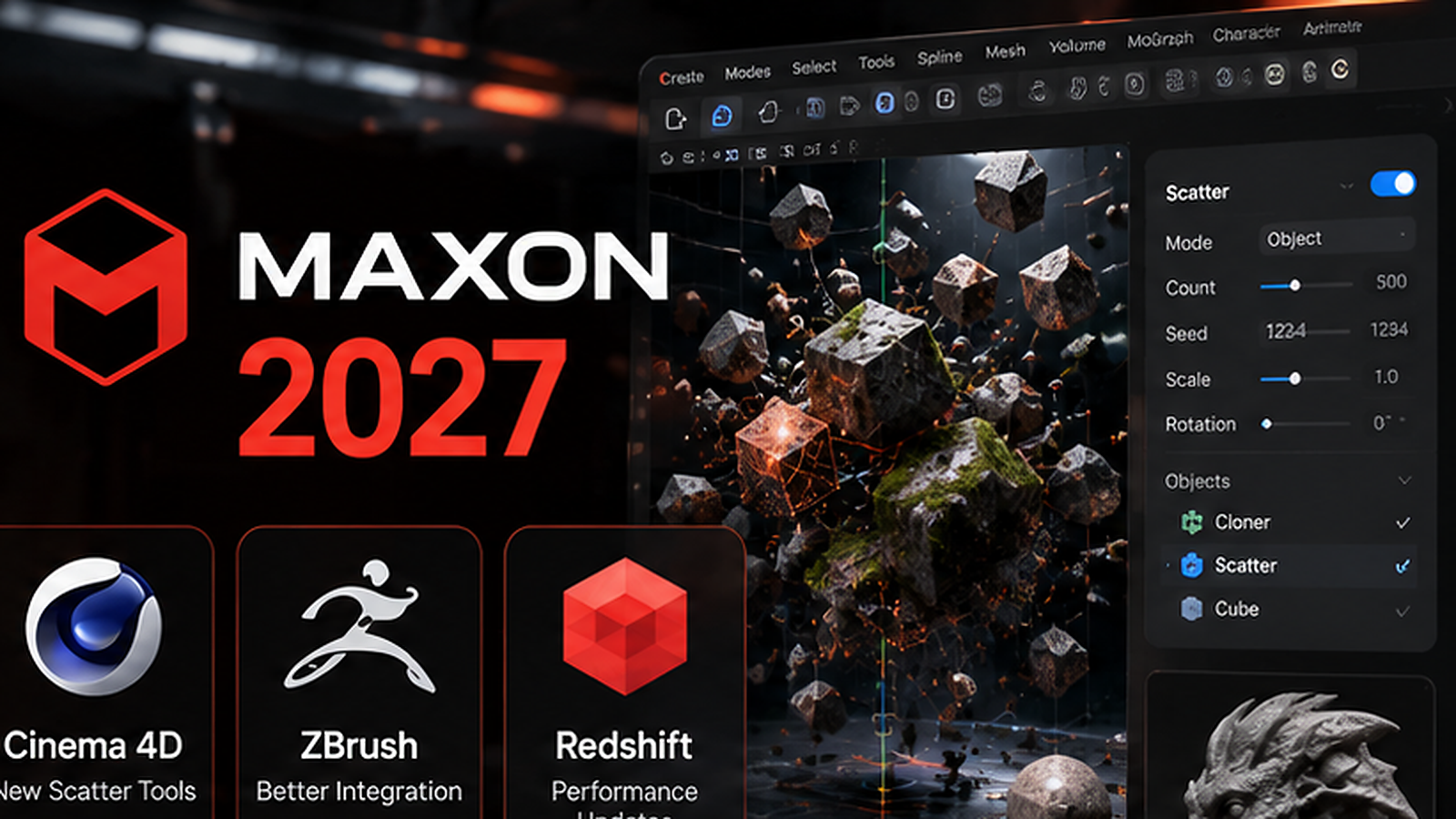
Maxon's Fall 2026 release brings major 2027.0 updates across Cinema 4D, ZBrush, Redshift, Red Giant and Autograph. The headline addition is a long-requested Scatter System in Cinema 4D, but the broader release also adds Liquid FX, deeper UV workflows in ZBrush, faster Redshift interaction and MCP-based automation in Autograph.
For motion designers and 3D artists, this is one of the more substantial ecosystem updates of the month because it improves several production stages at once rather than concentrating on a single AI feature.
Cinema 4D gets a native Scatter System
Maxon says the new Scatter System can populate environments with vegetation, debris, crowds and other repeated elements while giving artists controls for distribution, filtering, clustering and transformation.
The system integrates with Cinema 4D's existing MoGraph workflows, which should make it more familiar to artists already using effectors and procedural animation.
Liquid FX adds secondary fluid detail
The 2027.0 release also introduces Liquid FX, which Maxon describes as a faster way to add effects such as foam and bubbles to fluid simulations.
Secondary effects are often what make a fluid simulation feel believable, but they can add setup time and complexity. Automating more of that process can help artists reach a usable result faster.
ZBrush and Redshift also move forward
Maxon says ZBrush gets more complete UV workflows, while Redshift focuses on faster interaction and rendering feedback.
Those changes are less headline-grabbing than Scatter, but they matter because production speed often depends on reducing context switching and shortening the feedback loop.
Autograph adds MCP-powered workflows
Maxon is also bringing Model Context Protocol support into Autograph, along with a direct connection to Cinema 4D.
That signals a broader move toward agent-driven creative workflows, where external AI tools can interact with production software through structured commands instead of relying only on text instructions.
What artists should test first
Cinema 4D users should stress-test the new scatter tools with production-scale object counts, animation and MoGraph combinations. ZBrush users should compare the new UV workflow against their existing pipeline, while teams interested in automation should evaluate how much useful control MCP actually exposes.
The most valuable update will depend on the kind of work a studio already does, but this release gives almost every part of the Maxon pipeline something substantial to evaluate.
Sources and further reading
Read Maxon's Fall 2026 release announcement
Explore more articles on the Nejma Blog
GOT ANY QUESTIONS LEFT?
Maxon introduced a native Scatter System for distributing and art-directing large numbers of objects in complex scenes.
It is a new Cinema 4D workflow for adding secondary fluid effects such as foam and bubbles more efficiently.
Yes. Autograph adds Model Context Protocol support and a direct connection with Cinema 4D for deeper automation workflows.