mGear 5.4 Adds Free Maya Rigging Tools
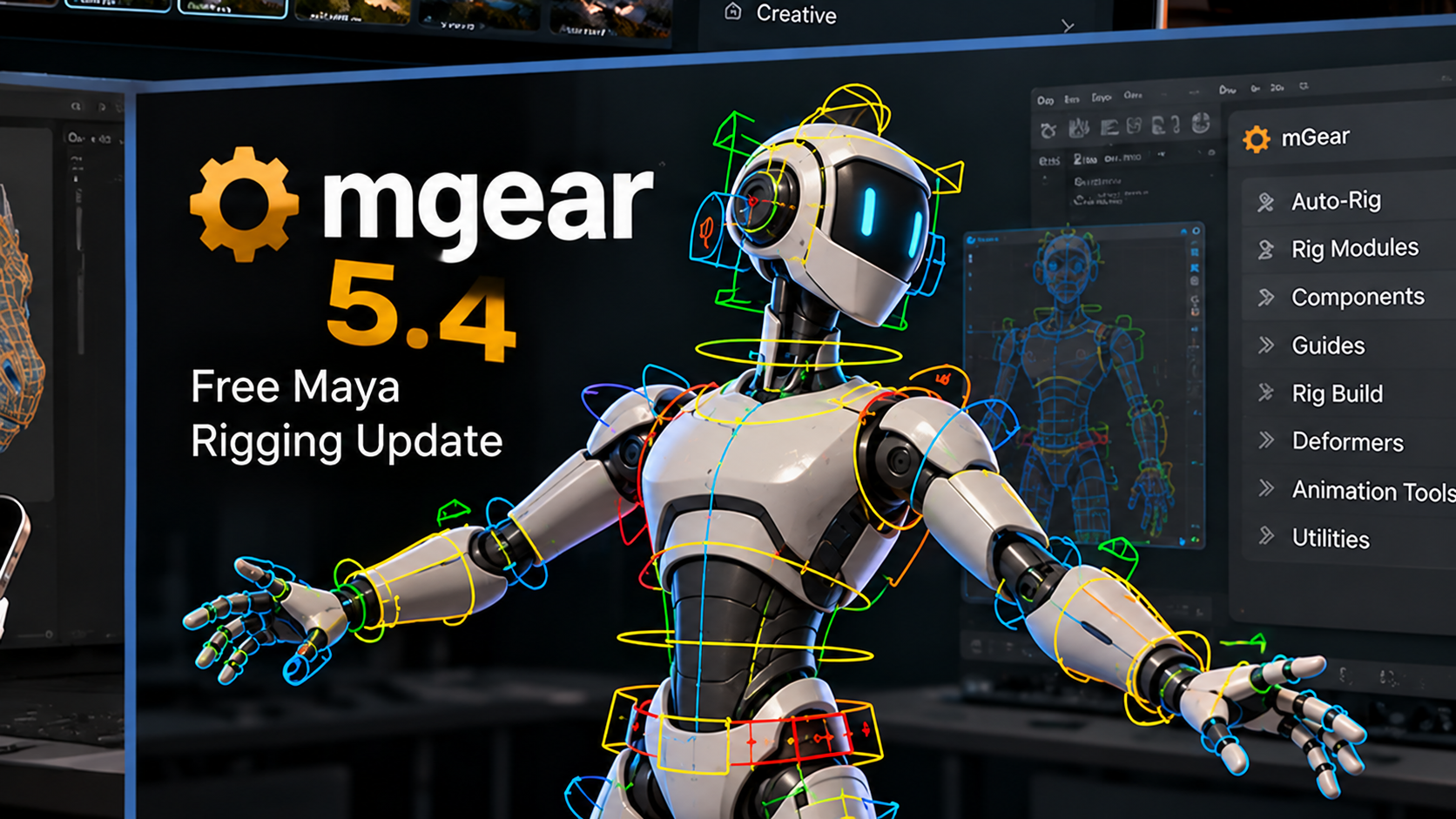
The open-source Maya rigging framework mGear released version 5.4.0 on October 14, 2026. It is a substantial update for character riggers and animators, with a unified Facial Rigger 3.0, a redesigned Anim Picker, new animation blocking tools, expanded deformer import and export, and faster Shifter rig builds.
Unlike a standalone animation program, mGear works inside Autodesk Maya. That distinction matters for artists searching for free creative software: the framework itself is free and open source, but it is not a free replacement for Maya. It is designed to improve the character-production pipeline for teams already using the host application.
Facial Rigger 3.0 unifies eyes, lips and brows
Previously separate facial riggers have been rebuilt on a shared engine. Eye, lip and brow tools now use a common window, geometry-selection workflow and configuration approach. The release includes options such as mirrored eye controls, jaw-follow behavior, lip roll and secondary brow controls.
This is useful for studios that build many characters with consistent requirements. A shared system can reduce training time and make rig components easier to reuse. The older Eye Rigger remains available, which is important for teams maintaining existing characters rather than rebuilding every asset at once.
Anim Picker 2.0 improves animator control panels
Anim Picker 2.0 introduces a rebuilt editor with on-canvas move, scale and rotate handles, alignment tools, vector items and SVG support. It also supports interactive sliders, checkboxes, mirrored items, saved shapes and different background layouts.
A picker is the interface animators use to select and control a character quickly. Better picker design can make complex rigs feel less technical, especially when many facial and body controls would otherwise be scattered across the viewport or scene hierarchy.
Blocking Ghosts makes motion easier to judge
The new Blocking Ghosts tool shows semi-transparent versions of a character at watched keyframes. As keys change, the ghosts update, allowing animators to inspect pose spacing and silhouettes without repeatedly scrubbing the timeline.
This is especially useful early in animation, when the goal is to establish strong poses and clear timing before polishing secondary movement. The visual feedback can help reveal a jump in spacing or an awkward silhouette that is easy to miss when viewing one frame at a time.
Animbits Hub puts frequent tools near the cursor
Animbits Hub is a hotkey overlay with tweening, blending, mirroring, pose and keyframe tools. It brings common actions closer to the artist rather than requiring repeated trips through menus. For animators working through hundreds of pose adjustments, saving small interactions can add up.
The feature is not a substitute for understanding timing or posing. Its value is reducing mechanical interruptions so artists can spend more attention on the performance. Teams should still standardize hotkeys and picker conventions before deploying it across multiple artists.
Spring Manager and deformer tools get production upgrades
Spring Manager 2.0 adds a refactored solver setup, multi-spring editing, presets and improved bake options. The release also introduces import and export utilities for lattice, shrink-wrap and proximity-wrap deformers, preserving information such as weights, memberships and deformer order.
These are the kinds of technical details that rarely generate flashy demos but can save significant cleanup in a studio. Moving a rig between scenes or rebuilding a character variation is easier when deformation settings can be transferred predictably instead of reconstructed by hand.
Shifter builds are reported to be faster
The mGear team says Shifter rig builds are approximately twice as fast, primarily through optimized node creation and attribute lookups. The update also warns about certain loaded plug-ins that can slow repeated builds and introduces options to validate components before construction.
A faster build cycle matters when riggers iterate repeatedly on guides and components. Still, the reported improvement is a developer estimate, not a guarantee for every scene. Compare build time, memory use and resulting rig behavior on representative studio characters before planning around a specific speedup.
Compatibility and migration require attention
The release notes list support for Maya 2022 through Maya 2027. Teams should match the correct mGear package and dependencies to their Maya environment, then test on duplicate files before upgrading production scenes.
There is also a documented breaking change: bookmarks moved from Utilbits to Animbits. Existing shelf buttons or scripts that call the old bookmarks module may need updates. This is a good example of why even a free update deserves a controlled rollout in an established pipeline.
Who benefits most from mGear 5.4?
Character TDs building reusable rigs, animators using custom pickers and small Maya-based teams stand to benefit most. The facial system and deformer utilities target rigging work, while Blocking Ghosts and Animbits Hub make the update relevant to animators who do not build rigs themselves.
A sensible evaluation is to install the release in a test environment, rebuild one familiar character and ask an animator to work through a short blocking exercise. Compare rig build speed, picker usability and any compatibility problems before moving an active show or game production.
The bigger lesson for open-source creative tools
mGear illustrates a practical form of open source: improving a widely used professional application rather than trying to replace it. The project is community-developed, and its public release notes provide a detailed account of changes and limitations.
For Nejma readers, the appeal is not just that the download is free. It is that a mature production tool can gain meaningful features, remain inspectable and help studios customize workflows around their own needs. mGear 5.4 is a strong update to evaluate if Maya character work is part of your pipeline.
Sources and further reading
Official mGear 5.4.0 release notes and download
CG Channel breakdown, October 14, 2026
Explore more animation and 3D articles on Nejma
GOT ANY QUESTIONS LEFT?
Yes. mGear is free and open source, but it requires Autodesk Maya, which has its own licensing.
The official release notes list compatibility with Maya 2022 through Maya 2027.
Major additions include Facial Rigger 3.0, Anim Picker 2.0, Blocking Ghosts, Animbits Hub, deformer transfer tools and faster Shifter builds.
Test it first on copies of projects. The release includes a bookmarks-module breaking change that can affect existing scripts and shelf buttons.