Epic Games Moves Disney Project to AI-First Development
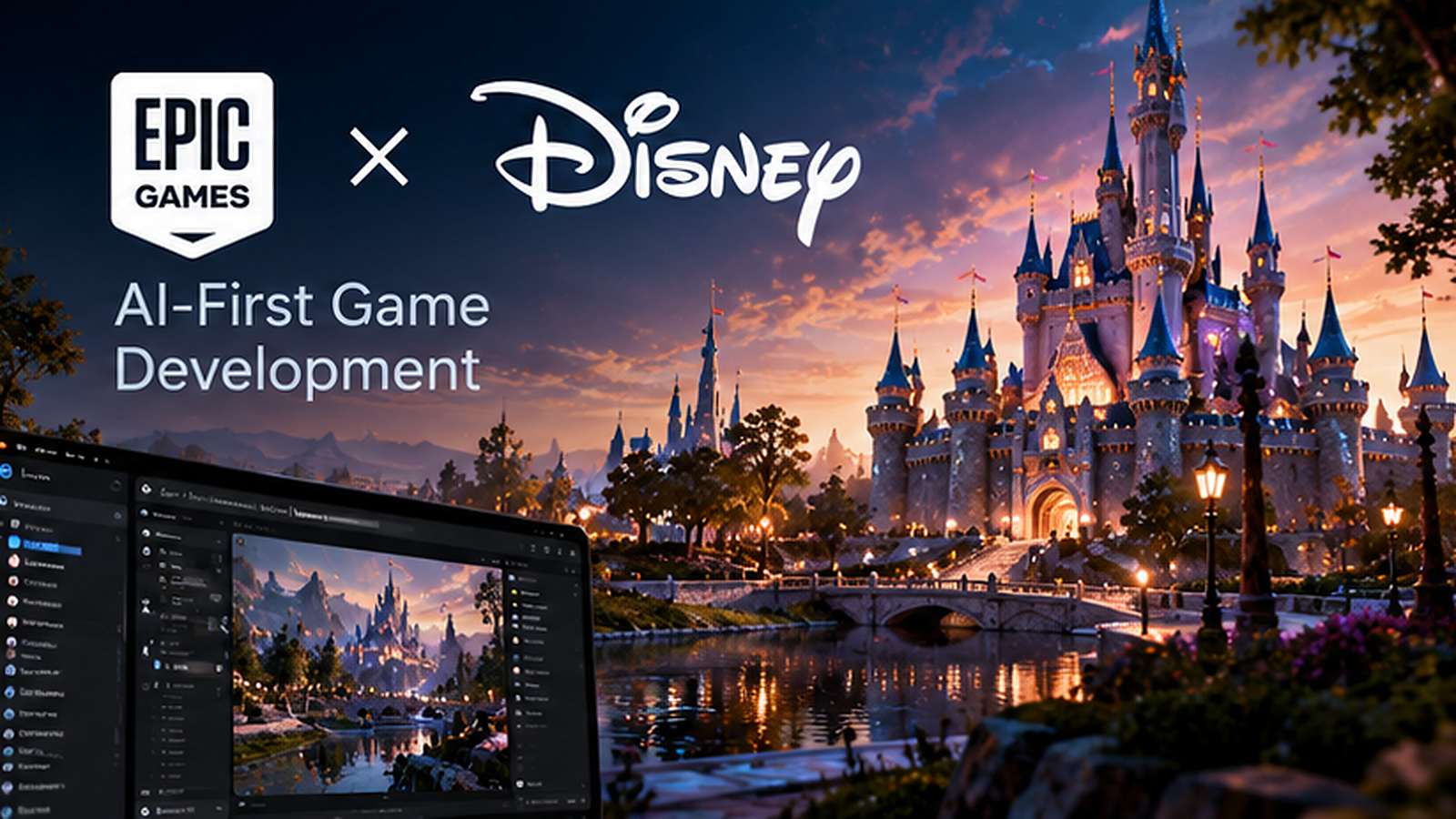
Epic Games is making a major bet on AI-assisted game production. Reporting published October 12 and 13 says an unannounced Disney collaboration has been delayed while its developers move toward an “AI-first” approach involving generated code and artwork. Epic has publicly described the direction as AI-accelerated development, while its CEO argues that the goal is to let teams produce more, not simply cut headcount.
The story matters well beyond gaming. It is one of the clearest high-profile examples of a creative company attempting to reorganize a large production workflow around AI, rather than adding a few isolated generative features to an existing pipeline.
The reported Disney project has been delayed
Bloomberg reported that Epic postponed an upcoming shooter connected to its Disney collaboration. The game is said to feature characters from Marvel and Star Wars, but the project remains unannounced and its final scope has not been publicly demonstrated.
The title had reportedly targeted a March release window before the delay. As of October 19, there is no newly confirmed launch date. That distinction matters because an internal production plan can change substantially before the public sees a finished game.
Developers were reportedly told to use AI-first workflows
According to the reporting, internal direction encouraged developers to rely heavily on tools such as Claude for code generation, with human teams managing and guiding the output. A director reportedly told staff to stop writing code by hand, while artwork was also expected to move through AI-heavy workflows.
Those are significant claims, but they describe reported internal instructions, not a verified inventory of finished assets. A production mandate does not guarantee that every generated line or image will survive review and reach the final product.
Epic frames the move as acceleration, not replacement
In comments reported by The Verge, Epic spokesperson Jake Jones described the company as embracing AI-accelerated development. CEO Tim Sweeney also said the objective was to help teams build more and better work and to spread the benefits across Unreal Engine users.
That is the optimistic interpretation: AI handles repetitive tasks, technical scaffolding and early experiments while human developers concentrate on design decisions, polish and testing. Whether the company can achieve that balance at scale remains an open question.
Why artists and developers are concerned
The phrase AI-first raises difficult questions about creative authorship, training data, job security and quality control. Game art requires a coherent visual language across thousands of assets. A model that creates a striking concept image does not automatically deliver production-ready topology, rigging, animation or consistent in-engine results.
Code generation creates different risks. Large games rely on maintainable systems, performance budgets, deterministic behavior and extensive testing. A fast first draft is useful only if engineers can understand, verify and support it throughout the project’s life.
AI-assisted work is not the same as AI-only production
Many studios already use procedural tools, automation and machine learning for limited tasks. An AI-first strategy goes further by making generated work the default starting point for major categories of production.
The difference is operational. A team must define review gates, asset provenance, code ownership, version control, style consistency and clear accountability when something breaks. Without those guardrails, the apparent speed of generation can become a long cycle of corrections.
What the shift means for creative software
Epic owns Unreal Engine, a central platform for real-time 3D production. A successful AI-accelerated pipeline inside Epic could influence how game teams, virtual-production studios and independent creators use assistants alongside their existing tools.
The most useful capabilities would be ones that produce editable, inspectable results: a script that passes tests, a material that can be adjusted, a scene that remains organized, or an animation that a human artist can refine. Purely flattened outputs are harder to integrate into a professional pipeline.
The business case is still unproven
AI can reduce the cost of exploration, but the savings depend on how much human review and rework remain. Generated assets may introduce legal uncertainty, while generated code may create maintenance costs that are difficult to measure during a prototype.
The Disney project is therefore a useful real-world test, not proof that traditional game production is obsolete. The important outcomes will be delivery time, technical stability, visual quality, staff experience and audience response when the work is finally shown.
What independent creators can learn now
Small studios do not need to copy an enterprise-wide AI-first mandate. A safer experiment is to choose one contained task: rough storyboards, placeholder textures, test scripts or asset tagging. Measure time saved, error rate and revision effort against the existing process.
Keep human ownership of the creative brief, final selection and quality bar. If AI makes the first 80 percent faster but the last 20 percent harder, the team needs to know that before rebuilding its production process around the tool.
The wider industry question
The debate around Epic is not simply whether AI can generate images or code. It is whether companies can build reliable creative systems around generated material without losing accountability, craft and trust.
For designers, developers and filmmakers, the practical answer will emerge from shipped work rather than announcements. The next milestone is not another impressive demo. It is a complete production that people can inspect, use and judge on its merits.
Sources and further reading
Bloomberg reporting republished by Yahoo Finance
The Verge: Epic shifts to AI-accelerated development
More creative industry coverage on Nejma
GOT ANY QUESTIONS LEFT?
No. Reporting says the unannounced Disney collaboration has been delayed, with no newly confirmed launch date as of October 19, 2026.
Epic says its goal is to accelerate teams rather than simply reduce headcount. Reporting describes an AI-first production push, but does not establish that humans are being removed from all roles.
Internal instructions reportedly called for AI-heavy art workflows, but the final assets and production methods have not been publicly demonstrated.
Test AI on contained, measurable tasks first. Track review time, maintainability, consistency and rights before making generated work the default.