The Arc Shows What AI Filmmaking Really Costs
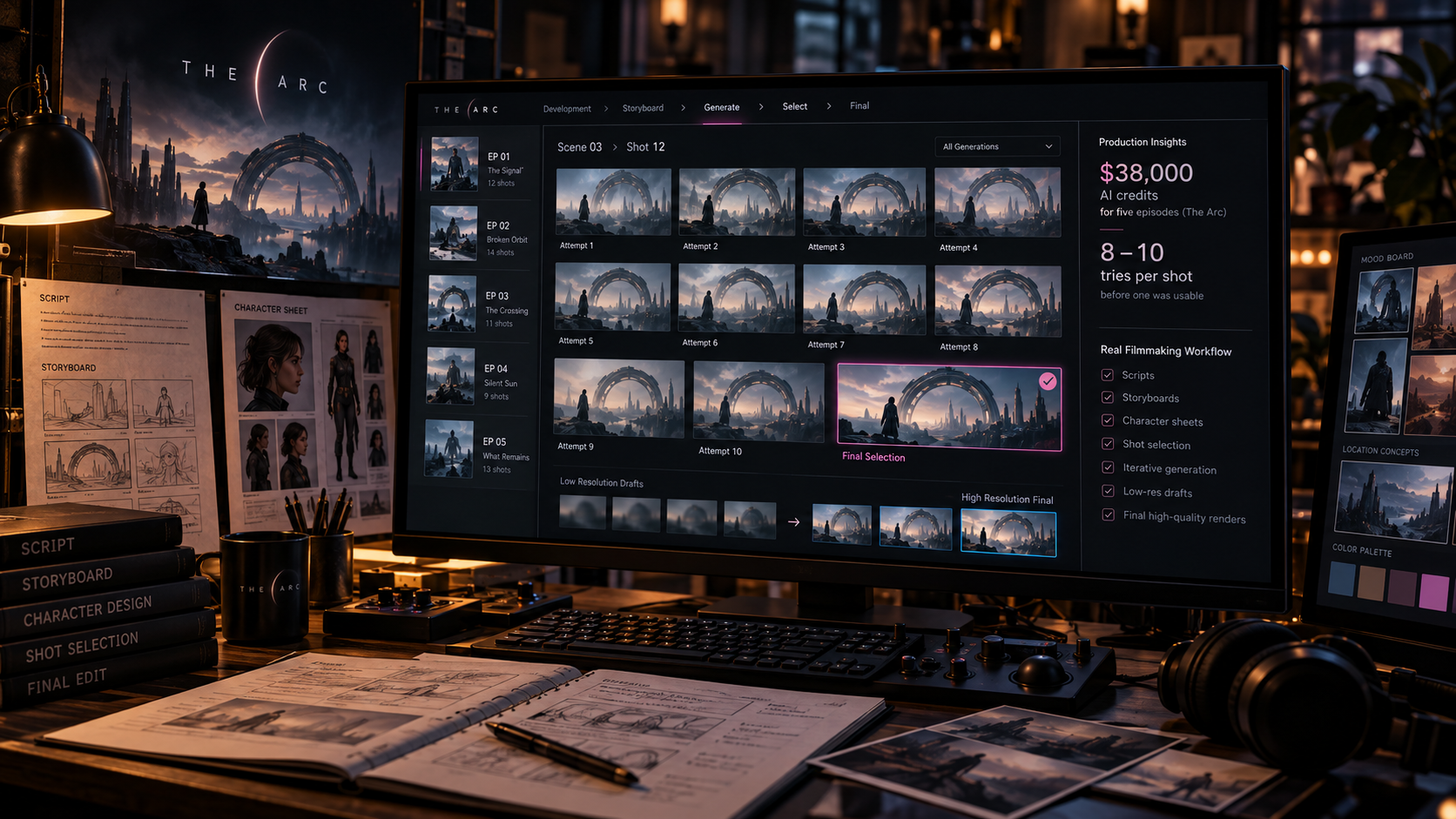
The creators of the AI-generated sci-fi series The Arc have revealed a number that gives a much clearer picture of what high-end AI filmmaking actually costs: about $38,000 in AI credits for five episodes, with individual shots often requiring eight to ten generations before the team got a usable result.
That makes the project more useful as a case study than as a simple AI demo. It shows both the dramatic production advantages of generative video and the amount of iteration still required behind the scenes.
The series was made without traditional sets or actors
The Arc is a five-episode sci-fi action series with roughly 83 minutes of total runtime. The filmmakers used AI-generated video instead of conventional actors, physical sets, props and costumes.
That made it possible for a small team to create scenes across different historical periods and locations that would normally require a much larger production budget.
The team used about $38,000 in AI credits
According to Business Insider, the production used roughly $38,000 in AI credits supplied by Artlist.
The average came to about $7,600 in AI credits per episode, with episodes ranging from around 10 to 22 minutes.
A single shot often needed eight to ten generations
Director Darin Stewart said the team frequently generated a shot eight to ten times before reaching the version they wanted.
That number is more revealing than the headline cost because it shows why AI filmmaking is still heavily dependent on selection and creative judgment. The first generation is often only the starting point.
The workflow still looked like filmmaking
The team developed storylines, characters, locations and camera ideas before generation. They also built character sheets and mood boards using tools including Figma.
For scripts, the filmmakers used Claude to turn verbal story outlines into workable drafts that were then edited by the team.
Several AI systems were used together
The production did not rely on one universal model. The workflow included tools such as Nano Banana Pro and GPT Image 2 for still-image work, while Seedance and Kling handled much of the generated video.
That reflects how current AI production often works: different models are chosen for different stages, and the production pipeline becomes an orchestration problem.
The team used low resolution to control costs
The filmmakers said they generated early attempts at lower resolution and only increased output quality once they had the shot they wanted.
That is a practical cost-control technique for AI video. High-resolution generation is expensive, so spending premium credits before the composition is approved can waste a large part of the budget.
AI filmmaking is cheaper, but not effortless
The production shows that AI can make ambitious visual storytelling possible for smaller teams, especially when scenes would otherwise require expensive travel, sets or visual effects.
At the same time, the project pushes back against the idea that cinematic AI video is simply a prompt-and-export workflow. Direction, continuity, selection and revision remain substantial parts of the process.
What creators should take from The Arc
Independent filmmakers should budget for iteration rather than assuming every prompt will produce a usable shot. A realistic plan needs room for failed generations, continuity fixes and quality upgrades.
The most interesting opportunity is not eliminating creative work. It is letting smaller teams attempt stories that would previously have been financially impossible.
Sources and further reading
Read Business Insider's production breakdown
Explore more articles on the Nejma Blog
GOT ANY QUESTIONS LEFT?
The filmmakers said the five-episode series used roughly $38,000 in AI credits supplied by Artlist.
Director Darin Stewart said a usable shot often required around eight to ten generations.
Yes. The series used AI-generated video rather than a conventional physical production with human actors, sets, props and costumes.





