Nano Banana 2.1 Improves AI Image Editing
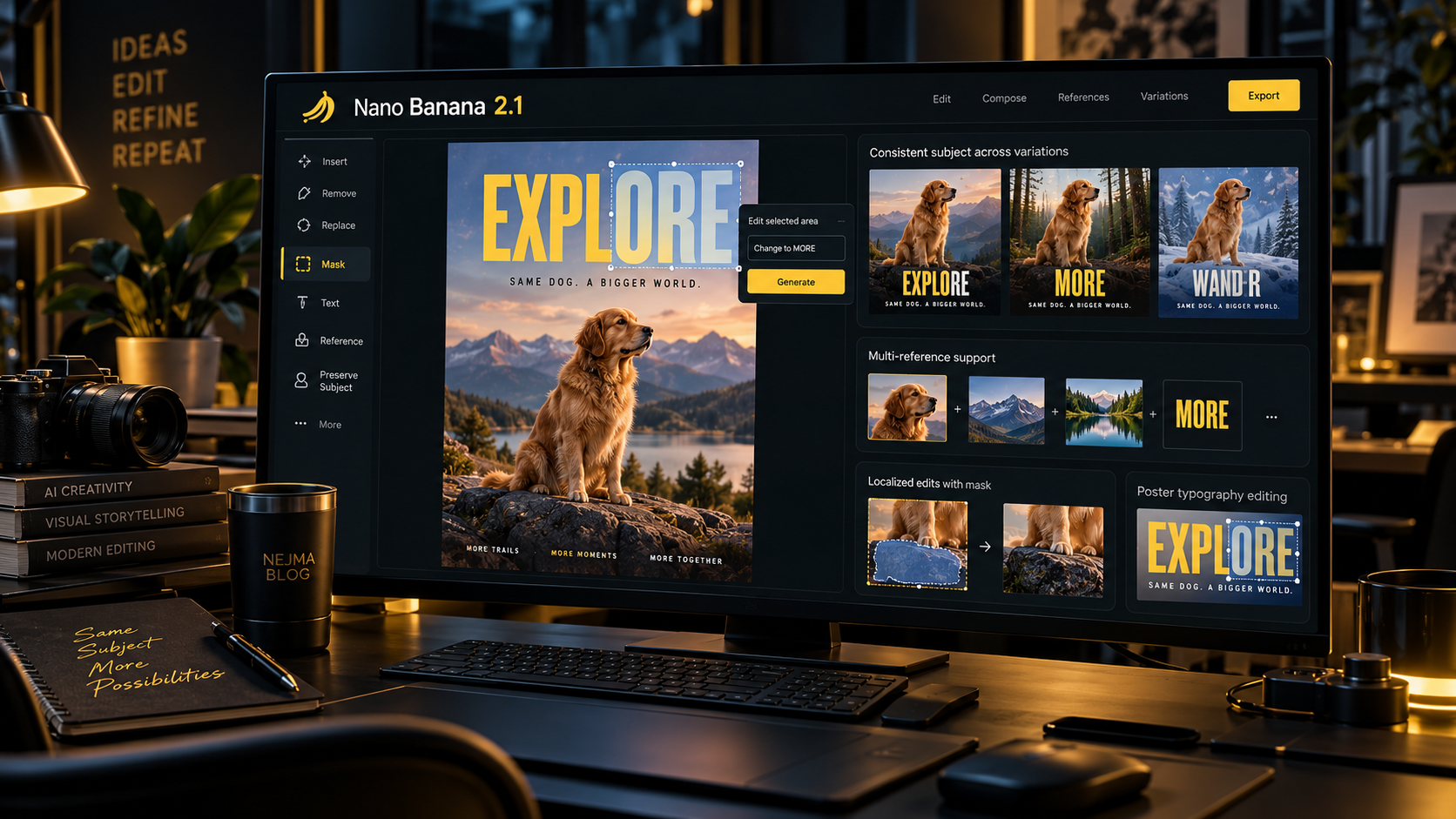
Google has released Nano Banana 2.1, an updated image-generation and editing model that is attracting attention for a practical reason: it focuses on the mistakes that make AI imagery hard to use in real design work. Google introduced the model on October 6, 2026, and independent reviewers have since been comparing its poster typography, lighting and character consistency with rival image tools.
Nano Banana 2.1 builds on Gemini 3.6 Flash and is available through the Gemini app, Google AI Studio, the Gemini API and other Google products. Google positions it as a fast image model with better visual design, mask-based editing, multi-reference work and consistent subjects across revisions. Those are precisely the features that matter to people producing campaigns rather than one-off experiments.
What changed in Nano Banana 2.1
Google says the model improves general image editing, stylization, product consistency, character editing and multi-reference tasks. Its October model card compares the new release with Nano Banana 2 and Nano Banana Pro on a range of internal and human-preference evaluations, reporting gains across several editing categories.
The results are evidence of Google’s testing, not a guarantee that every prompt will improve. Independent comparisons have also found that the choice between Nano Banana 2.1 and competing image models still depends on the specific task.
Mask-based editing could reduce wasted generations
A common failure in generative editing is changing more than the user requested. Ask to replace a background, and the model may also alter a product label, facial features or garment details. Mask-based workflows are designed to give the system a clearer indication of which area should change.
For commercial photography and branded content, a useful test is to isolate one element and see whether surrounding geometry, text and identity remain stable. The result still needs visual inspection, especially where the mask meets hair, glass or fine edges.
Text and poster design are important use cases
Google specifically highlights image generation for posters, diagrams and infographics, including clearer localized text. That matters because designers often need a visual that communicates exact words rather than decorative pseudo-lettering.
However, the official model card warns that small text and long passages can still render poorly. Critical copy, pricing and legal disclosures should therefore remain in an editable design layer whenever possible instead of being trusted inside a generated bitmap.
Subject consistency matters for campaigns
A campaign may need one product photographed in several settings or the same character across a sequence of images. Nano Banana 2.1 is designed to improve consistency during those multi-turn and multi-reference tasks.
That does not mean identity preservation is perfect. Google explicitly acknowledges remaining character-consistency errors. Creators should compare key details such as packaging, hands, logos, facial proportions and accessories before publishing a set.
Where creators can use it
Google lists distribution through the Gemini app, AI Studio, the Gemini API, Search AI Mode, Ads, Flow and Stitch. Actual access, usage limits and billing depend on the product and account, so a feature available in AI Studio may not appear identically in every consumer interface.
For developers, the stable API model identifier is gemini-nano-banana-2.1. Teams should test any migration against their own production prompts and check current Google lifecycle notices rather than assuming older model identifiers will remain supported indefinitely.
Pricing changes the economics of bulk imagery
Coverage of the October 6 release reports lower image-output prices than the previous Flash image model. That can make a meaningful difference when a creative workflow generates dozens of variations for product listings, thumbnails or ad concepts.
A cheaper generation is not automatically a cheaper finished asset. The right metric is cost per approved image, including failed outputs, manual corrections and any additional retouching or design time.
A simple quality-control test for your next project
Create a small benchmark using five repeatable tasks: a poster with exact text, a product-background swap, a character in three scenes, a masked object replacement and a composition with difficult reflections. Keep the same reference files and evaluate each result for accuracy, consistency and editability.
If Nano Banana 2.1 reduces revisions on the tasks you perform every week, it is a useful upgrade. If a competing tool preserves details better on a particular asset type, a mixed-model workflow may still be the better choice.
Sources and further reading
Read Google DeepMind’s Nano Banana 2.1 model card
Read Android Authority’s October 6 launch coverage
Read a recent independent comparison with ChatGPT Images
Explore more articles on the Nejma Blog
GOT ANY QUESTIONS LEFT?
Google introduced Nano Banana 2.1 on October 6, 2026.
Google highlights image creation and editing, especially posters, diagrams, masked edits, stylization and maintaining subjects across revisions.
No. Google’s model card still lists weaknesses with small text, long paragraphs, subject consistency and some spatial instructions.
Google lists Gemini, AI Studio, its API, Search AI Mode, Ads, Flow and Stitch, subject to the availability and limits of each product.





