Canva ProSuite Challenges Adobe Workflows
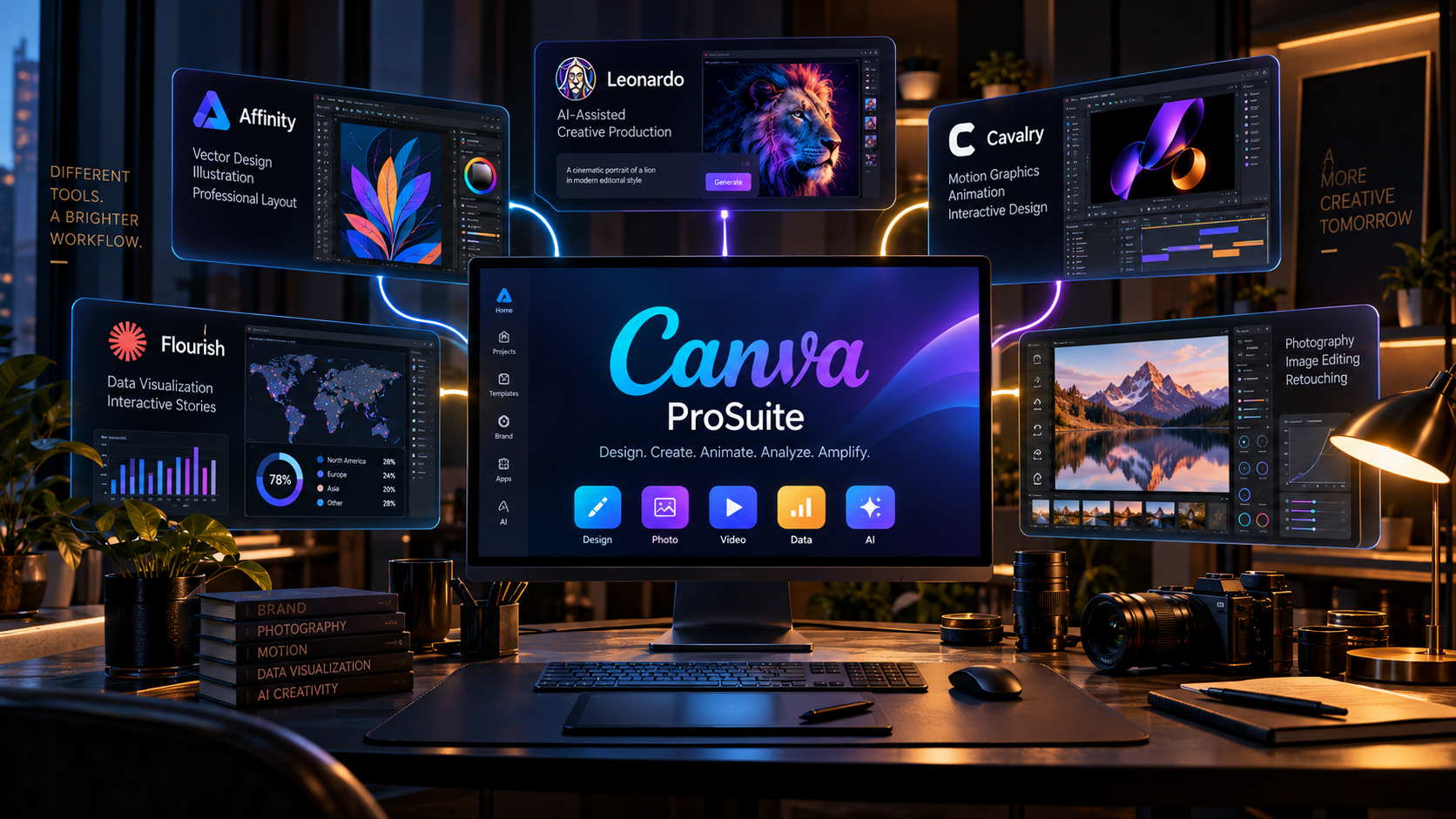
Canva is making a much more direct play for professional creative workflows with ProSuite, announced September 16, 2026. Instead of treating Canva as a lightweight design app, the company is connecting Affinity, Cavalry, Flourish and Leonardo into a wider ecosystem for vector work, photography, animation, data visualization and AI-assisted production.
The announcement is especially important to designers considering alternatives to traditional subscription suites. Canva says the core Affinity and Cavalry platforms remain free to use, while some AI features require a premium Canva plan. That distinction matters: a free professional editing foundation is not the same thing as unlimited free access to every service.
Affinity adds the long-requested Blend Tool
The September update introduces a live Blend Tool with controls for spacing, curves, bias, easing and morph mapping. Designers can build repeated or transitioning vector forms without placing every element manually.
This matters to logo designers, illustrators and branding teams because blends are a foundational technique rather than a novelty feature. The tool is editable, so a designer can revise the path or shape without reconstructing the whole composition.
Scripting brings automation into one document
Affinity now supports custom scripts across vector, pixel and layout work in the same document. Canva also describes a Claude connector for automating repetitive tasks through natural language.
For studios, automation can be more valuable than a single generated image. Batch changes, repetitive print preparation and consistent asset output can consume hours across a campaign. Teams should still inspect automated edits and keep versioned originals.
Photography tools get a major update
Canva highlights an improved RAW development engine, batch import, reusable looks and automatic corrections for mixed lighting and camera shake. It also introduces AI-assisted Scene Decomposition, designed to reconstruct editable layers from a flattened image.
Scene Decomposition is particularly relevant to designers receiving assets with no source files. But reconstruction is not guaranteed to recover the original structure perfectly. Text, intricate masks and overlapping objects may still need manual correction.
Cavalry brings motion graphics closer to Canva
Canva says Affinity files can open directly in Cavalry with layers intact. It is also planning a handoff where selected parts of a Cavalry animation, such as text or color, can be edited inside Canva while the underlying scene stays protected.
The direct file opening is described as available, while the editable-animation handoff is described as coming soon. That difference matters for production planning. Teams should not promise a future integration to clients until it is shipping in their accounts.
Flourish and Leonardo complete the wider picture
ProSuite includes Flourish for data visualization and Leonardo for AI-assisted visual ideation. Canva presents the ecosystem as a pipeline: develop a design, animate it, visualize data, create variations and then distribute through Canva.
The value is in reducing file handoffs between specialized tools. Whether that saves time will depend on how well formats, fonts, effects and permissions survive the trip from one application to another.
What is actually free?
Canva says the core Affinity and Cavalry platforms remain free to use. The Canva AI Studio in Affinity requires a Canva premium plan. Other connected services can have separate access conditions.
That makes ProSuite a serious option to investigate for budget-conscious professionals, but the total cost of a studio workflow should include premium AI, storage, collaboration and any other required subscriptions. Avoid assuming every feature in the connected ecosystem is free.
Does ProSuite replace Adobe Creative Cloud?
It covers more of the creative pipeline than Canva previously did, but feature overlap does not mean perfect parity. Adobe-based studios may depend on particular plug-ins, scripts, collaborative review systems, color pipelines and interchange formats.
The most sensible approach is a pilot project. Test one real client asset through Affinity, Cavalry and Canva, then measure editability, export quality, time saved and failure points. That evidence is more useful than comparing product lists.
The larger industry shift
Canva is competing on connected workflows and accessible professional tools at a moment when creators are actively discussing subscription costs and open alternatives. ArtCraft has captured attention with experimental open-source clones, while Canva is making a different bet on a coordinated professional ecosystem.
For designers, more credible options create leverage. The winner will not simply be the app with the most features, but the stack that preserves creative control, reliability and collaboration while reducing friction between stages.
Sources and further reading
Canva official ProSuite announcement (September 16, 2026)
Explore more creative technology coverage on Nejma
GOT ANY QUESTIONS LEFT?
It is Canva’s connected professional creative ecosystem bringing Affinity, Cavalry, Flourish and Leonardo into a wider workflow.
Canva says the core platforms remain free to use, although certain AI features and connected services can require paid access.
Canva has announced that selective in-Canva editing of Cavalry animation elements is coming soon; it should not be treated as universally available yet.
It is an AI-assisted Affinity feature intended to separate a flattened image into editable layers for further refinement.





