OpenAI Publishes a Practical Guide to GPT-6
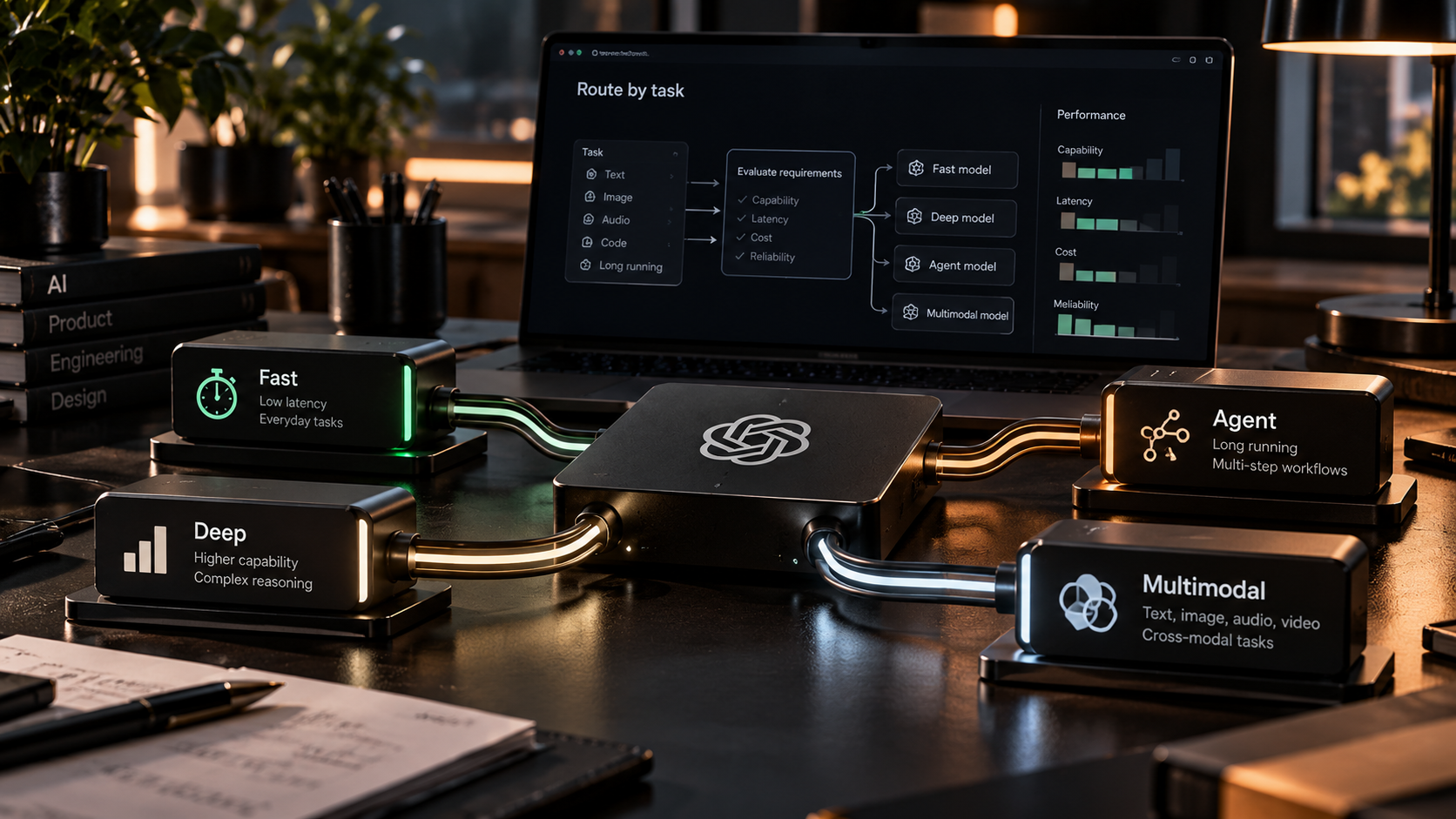
OpenAI has published a practical guide for teams building with the GPT-6 family. The useful part is not another list of benchmark numbers. The guide frames model choice as a workflow decision involving capability, latency, cost and the amount of reasoning a task actually needs.
That approach is increasingly important because modern AI products rarely have one model that should handle everything. A team may need a fast model for high-volume routine work, a stronger model for difficult professional tasks, and a different configuration for long-running agent workflows.
Model choice is becoming a product decision
Teams used to ask whether an application used AI at all. The more useful question now is which model handles which part of the system. A support classification step and a complex research task do not need the same level of intelligence.
Choosing deliberately can reduce cost and latency without reducing quality where it matters.
Start from the job, not the model name
A good model-routing strategy begins by defining the work. Is the task simple extraction, routine drafting, code generation, deep analysis, multimodal understanding, or a long sequence of actions? Those requirements should determine the model.
This prevents teams from designing around hype. If a lightweight model handles a repeated task reliably, there may be little value in sending every request to a frontier model.
Latency matters in interactive products
A few extra seconds can be acceptable for a complex report but frustrating for an interface action that users perform repeatedly. Response time becomes part of the product experience.
Teams should measure perceived latency, not just benchmark speed. Streaming, tool calls, retries and post-processing all affect how fast the final result feels.
Cost should be measured per useful outcome
Raw token price is only one part of cost. A cheaper model that fails often can create more retries, manual correction and support work.
The useful metric is cost per successful task, including human cleanup.
Long-running agents need different evaluation
Agent workflows introduce compounding risk. A model that is accurate on a single step may still drift over a long sequence of decisions.
Teams should test full trajectories, tool use, recovery from mistakes and how the system behaves when context becomes messy.
Build for change
Model families change quickly. Applications should avoid hard-coding assumptions that make every model upgrade a major engineering project.
Clear abstraction layers, evaluation sets and routing rules make it easier to adopt better models without destabilizing the product.
Sources and further reading
Browse OpenAI's current product guides
See OpenAI's current product releases
Explore more articles on the Nejma Blog
GOT ANY QUESTIONS LEFT?
No. Different tasks have different needs for reasoning, latency and cost.
Measure approved task quality, end-to-end latency, retry rate, cleanup time and total cost per useful outcome.
Model capabilities and pricing change quickly. Flexible routing makes upgrades easier.





