GitHub Copilot Expands Local Model and Agent Controls
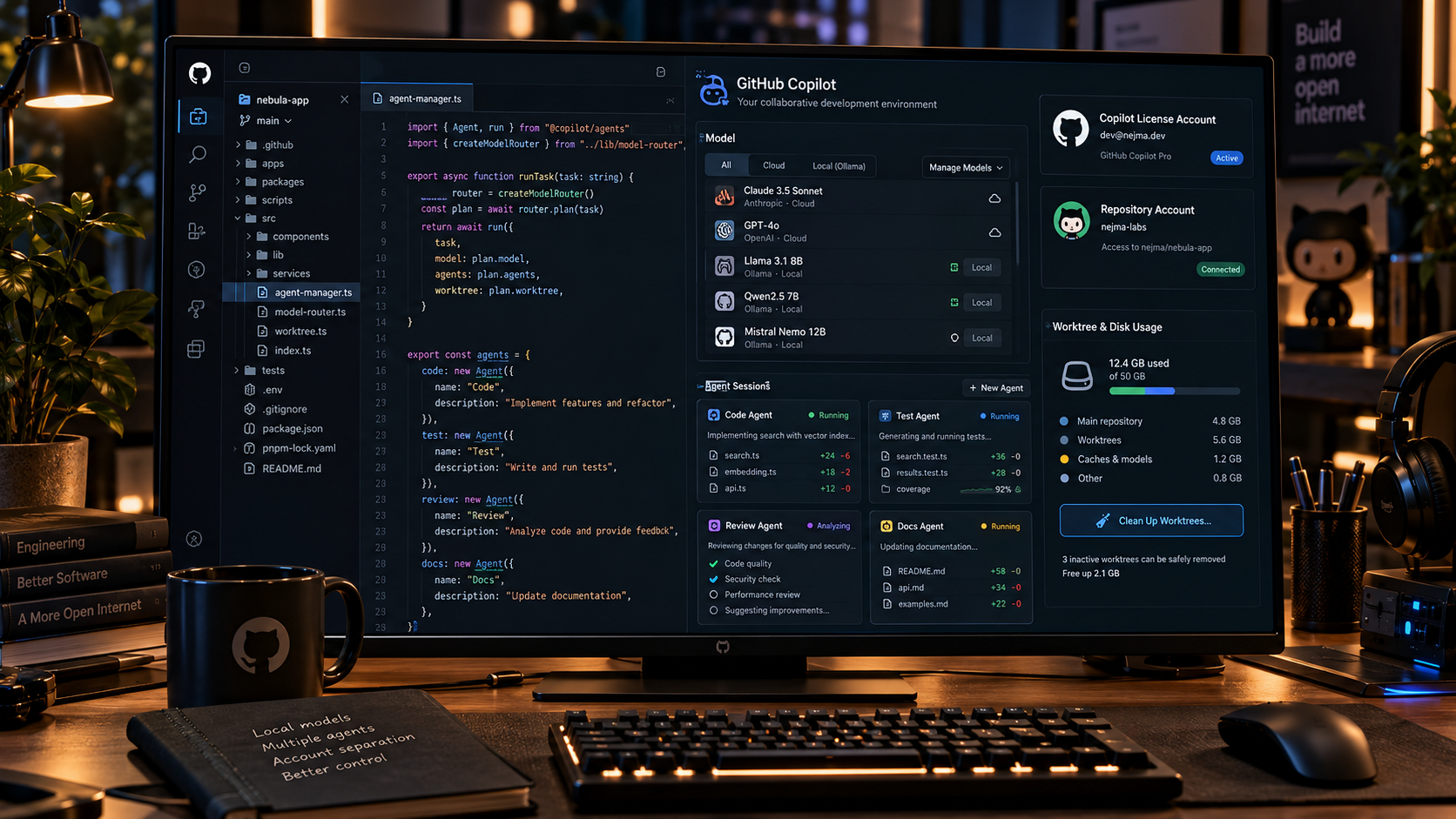
GitHub's latest Copilot weekly release expands how developers can use local models, separate work identities and manage multiple agent sessions. The changes are less about one headline model and more about making Copilot fit into increasingly mixed development environments.
The update is especially notable for developers who want to combine cloud models with local Ollama models or who use an employer-provided Copilot license while working with repositories under a different GitHub account.
Copilot CLI can discover local Ollama models
GitHub says the Copilot CLI can now use the /model command to discover supported models from a running local Ollama instance alongside configured and cloud models.
That makes local model use easier because developers do not have to leave the CLI workflow just to see what is available.
Local models give developers another control point
A local model can be useful when developers want lower latency for small tasks, more control over where data is processed, or a way to experiment without sending every request to a hosted model.
Local execution does not automatically make a model better or safer. Teams still need to evaluate output quality, hardware requirements, model licensing and what information the surrounding tools can access.
The Copilot app can separate license and repository accounts
GitHub also says the Copilot app can now use one GitHub account for the Copilot license and another for repository access.
That solves a real workplace problem. A developer may receive Copilot through an employer but still need to work with repositories connected to another account. Separating those identities reduces the need for awkward account switching.
VS Code can show several agent sessions together
The latest VS Code release can display agent sessions side by side in the Agents window and arrange them in a grid.
That is useful when several tasks are running at once because developers can compare outputs or monitor parallel work without repeatedly switching between individual sessions.
Agent worktrees also get cleanup tools
GitHub says developers can now inspect how much disk space inactive session worktrees are using and choose which ones to remove through chat.
This is a small operational improvement, but agent workflows can create temporary work that accumulates over time. Cleanup becomes more important as developers run more parallel sessions.
Copilot is becoming an environment rather than one assistant
Taken together, these updates show how coding assistants are evolving. Developers may use cloud models, local models, several identities and multiple concurrent agents inside one workflow.
The challenge is no longer simply getting a useful code suggestion. It is managing the surrounding environment so model choice, permissions, accounts and temporary work do not become their own source of friction.
What teams should standardize
Teams adopting mixed local and cloud workflows should document which models are approved, when local inference is appropriate, which repositories can be accessed and how account separation should be configured.
Giving developers more flexibility is useful, but shared defaults keep that flexibility from turning into an inconsistent or difficult-to-support toolchain.
Sources and further reading
Read GitHub's Copilot weekly release notes
Explore more articles on the Nejma Blog
GOT ANY QUESTIONS LEFT?
Yes. GitHub says the /model command can discover supported models from a running local Ollama instance.
Yes. GitHub now lets users separate the account providing the Copilot license from the account used to access repositories.
Yes. The Agents window can display sessions side by side and arrange them in a grid.





