Gemini 4 Argon Targets Long-Horizon Workflows
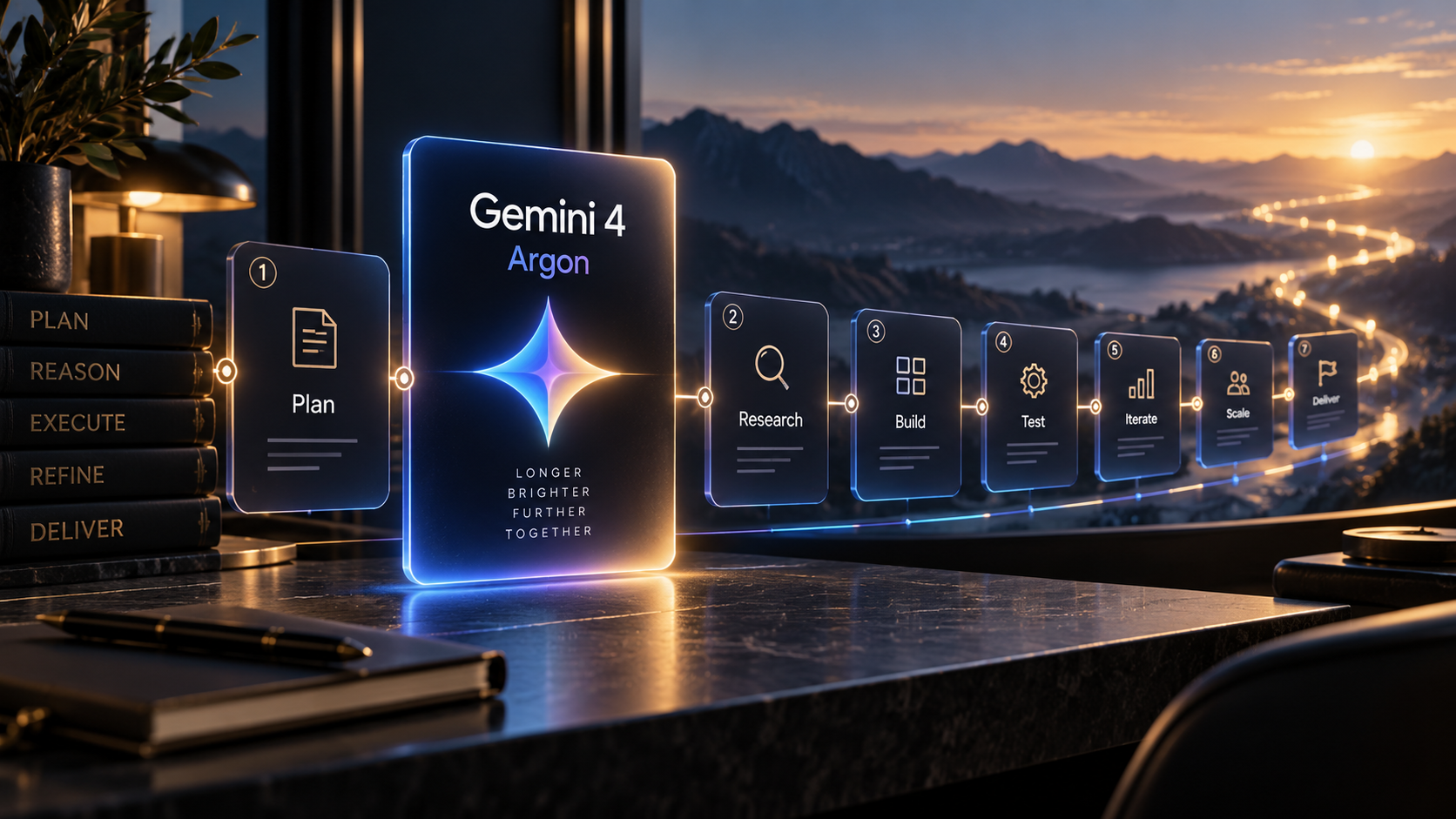
Google has introduced Gemini 4 Argon, a frontier model designed around difficult, long-horizon professional tasks rather than short conversational answers. Google highlights software engineering, enterprise knowledge work and cybersecurity as major target areas.
The most interesting part of the announcement is the emphasis on sustained trajectories. AI systems are increasingly being evaluated on whether they can keep working coherently through long, multi-step problems, not simply whether they produce a strong response to one prompt.
Argon is designed for sustained work
Google says Gemini 4 Argon is built for complex workflows that can require extensive reasoning and very large outputs. The model's output token limit reaches one million tokens, far beyond the size of a normal conversational response.
That capacity is intended for tasks such as large code migrations, deep research and long-running technical work where a system may need to plan, test and revise repeatedly.
Google is already using it internally
Google describes internal use cases including software migrations, memory optimization and engineering research. These examples matter because they test the model in workflows where the result has to survive verification rather than simply look convincing.
Long-running AI work is only valuable if the output can be audited and tested.
Cybersecurity drives the cautious rollout
Argon is initially being rolled out to trusted cyber defenders through Google's Fairwind Program. Google says wider access will expand gradually while guardrails are tested.
That phased release reflects the dual-use nature of advanced coding and security capability.
Large context does not remove the need for structure
A million-token output limit creates headroom, but more tokens do not automatically create a better workflow. Complex jobs still need clear goals, checkpoints, tools and verification.
Teams should resist treating context size as a substitute for process design.
Long-horizon evaluation is becoming more important
Traditional benchmarks often score one response. Agentic systems need different evaluation: completion rate, error recovery, tool use, cost, elapsed time and whether the final result passes real tests.
This is where professional adoption will be decided.
What this means for AI workflows
Argon is another sign that frontier AI is moving toward delegated professional work. Model capability is increasingly about sustaining a process, not only generating text.
For teams, that means the important questions shift toward orchestration, permissions, verification and where humans should remain in the loop.
Sources and further reading
Read Google's Gemini 4 Argon announcement
Explore more articles on the Nejma Blog
GOT ANY QUESTIONS LEFT?
Google positions it for complex long-horizon work such as software engineering, enterprise knowledge tasks and cybersecurity defense.
Google says the model is being released gradually to trusted testers and cyber defenders while safety guardrails are evaluated.
No. Large capacity helps with long tasks, but reliable workflows still need structure, testing and human oversight.





