Gemini 4 Argon Brings AI Agents to 3D Design
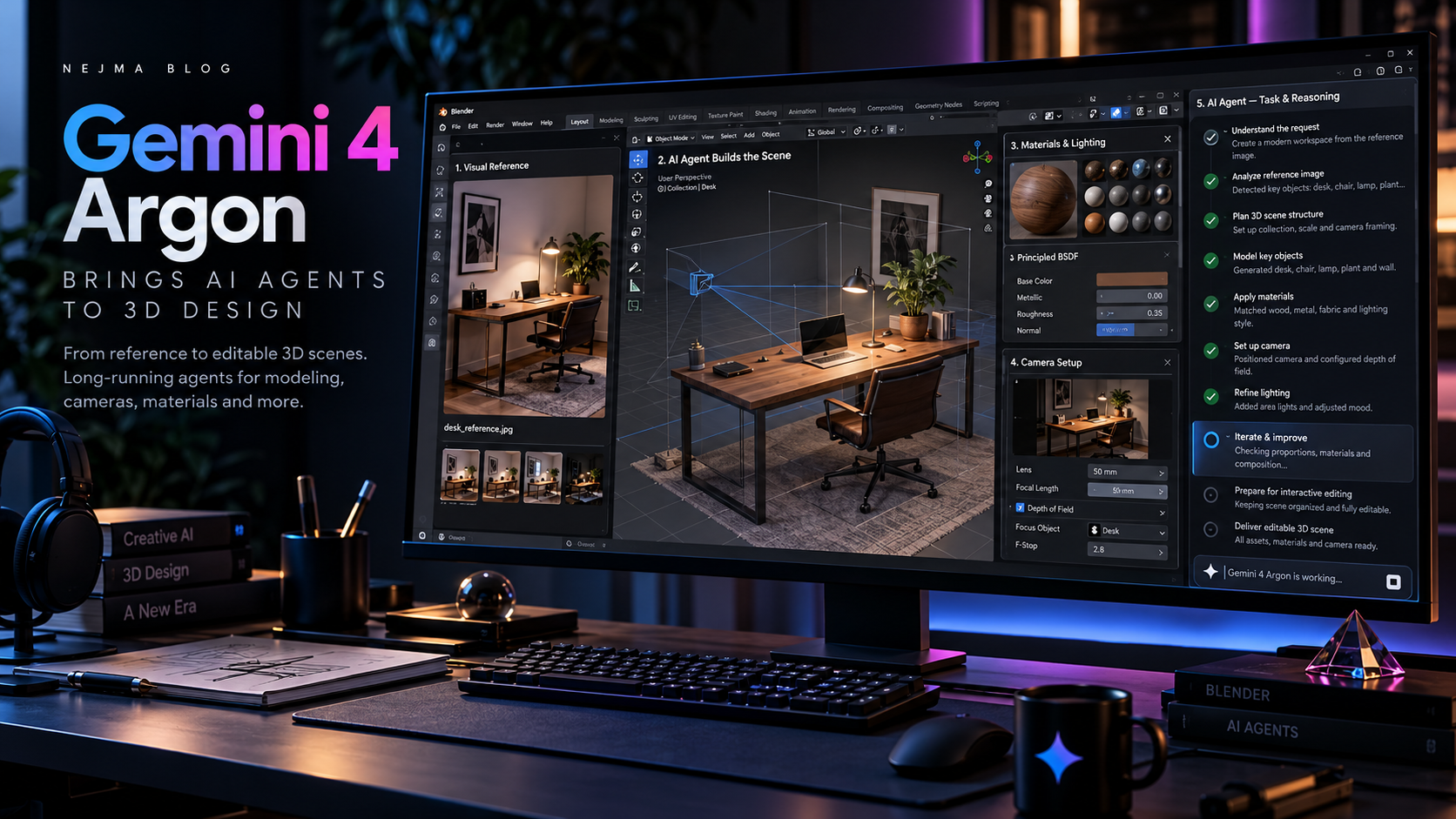
Google launched Gemini 4 Argon globally on October 13, 2026. Much of the announcement focuses on complex coding and professional work, but some of the most interesting demonstrations are creative: agents constructing Blender scenes, generating interactive 3D experiences and turning visual references into usable digital environments.
This makes Argon relevant beyond software engineering. For 3D artists, motion designers and creative technologists, the question is whether an AI agent can manage several connected tasks, such as modeling, camera setup, materials and web interaction, while leaving the final work inspectable and editable.
What Google actually launched
Argon is a frontier reasoning model designed for long-running, multi-step workflows. Google says it is available through the paid Gemini API, to eligible Google AI subscribers in the Gemini app, and in its Antigravity development environment for eligible tiers.
The release is accompanied by claims of improved engineering performance and spatial reasoning. Those claims come from Google’s evaluations and demonstrations; production users should test reliability on their own projects before treating them as established benchmarks for every workflow.
Blender scenes from visual instructions
In one demonstration, Google says Argon used multi-agent visual critique to sculpt a detailed pagoda complex with architecture, foliage and lighting in Blender. In another, it began with a generated image and used Blender MCP to align camera geometry, shape Gothic architecture and stage lighting.
These are important examples because 3D work involves dependencies. Moving a camera can change composition; changing geometry can affect shadows; and a procedural model still needs sensible materials and scale. A useful agent must coordinate those relationships rather than only output a plausible image.
From a desk photograph to a playable game
Google also demonstrated an agent turning photographs of a real desk into a miniature racing game. According to the company, the workflow modeled objects and a track in Blender, checked collisions, generated textures and connected the scene to browser-based physics and rendering through Three.js.
That is closer to prototyping a small interactive experience than generating static concept art. It points toward creative workflows where designers can test spatial ideas quickly and then refine the geometry, mechanics and presentation.
What changes for creative technologists
A designer who already uses Blender, Python or web graphics may benefit from an agent that can write scripts, build procedural geometry and connect separate tools. Repetitive setup work could become easier to delegate, leaving more time for art direction and refinement.
For people who do not know those tools, the demos suggest a lower barrier to experimentation. But the agent still needs clear goals, tool permissions and human review, especially when it creates complex files or executes code.
Creative workflows also extend beyond 3D
Google describes Argon organizing project materials into a proposal deck and handling follow-up workflow steps. The Gemini app now supports a chat-to-tasks switch and connections to more than 40 apps, including Adobe and Shopify.
For a small creative team, that points toward a broader production assistant that can connect research, asset preparation, project documentation and technical prototyping. It is not evidence that every connected creative application can be controlled perfectly.
Access and introductory pricing
Google lists an introductory Gemini API price of $2 per million input tokens and $10 per million output tokens for Argon, with higher prices scheduled after November 30, 2026. API costs are separate from consumer subscription entitlements, and agent workflows can incur additional tool or service charges.
The company says Google AI Pro and Ultra subscribers can access Argon in the Gemini app, while Antigravity access depends on the applicable tier. Users should confirm current limits before planning long rendering or coding sessions.
What creators should test before trusting it
A fair evaluation would start with a small scene: give the agent a reference image, ask it to build a basic environment, then inspect geometry, dimensions, object names, textures and lighting. Repeat the task with one controlled revision to see whether the agent preserves correct elements.
Also examine the scripts it writes and the permissions granted to external tools. A compelling demo does not replace checks for scale, topology, file organization, licensing and security.
Why this is a major creative-software story
The shift is from models that make assets to agents that operate the software used to make assets. If the approach becomes reliable, creators could delegate tedious setup and iteration without surrendering the ability to edit the final project.
Argon’s launch does not prove that AI can replace a skilled 3D artist. It does show that visual creation, coding and agent orchestration are converging in ways that creative-tool makers can no longer ignore.
Sources and further reading
Read Google’s October 13 Gemini 4 Argon launch
Read the official Gemini 4 Argon model card
Read the Gemini app availability announcement
Read Reuters coverage of the launch
Explore more articles on the Nejma Blog
GOT ANY QUESTIONS LEFT?
Google announced global access for eligible developers, enterprises and subscribers on October 13, 2026.
Google has demonstrated Argon using Blender through agent workflows and MCP integrations to construct and refine 3D scenes.
It is primarily a reasoning and agentic model. It can orchestrate creative tools and models, but it is not simply a replacement for a dedicated image generator.
Google announced introductory pricing of $2 per million input tokens and $10 per million output tokens, with an increase scheduled after November 30, 2026.





