Adobe Brings CX Enterprise Coworker to ChatGPT
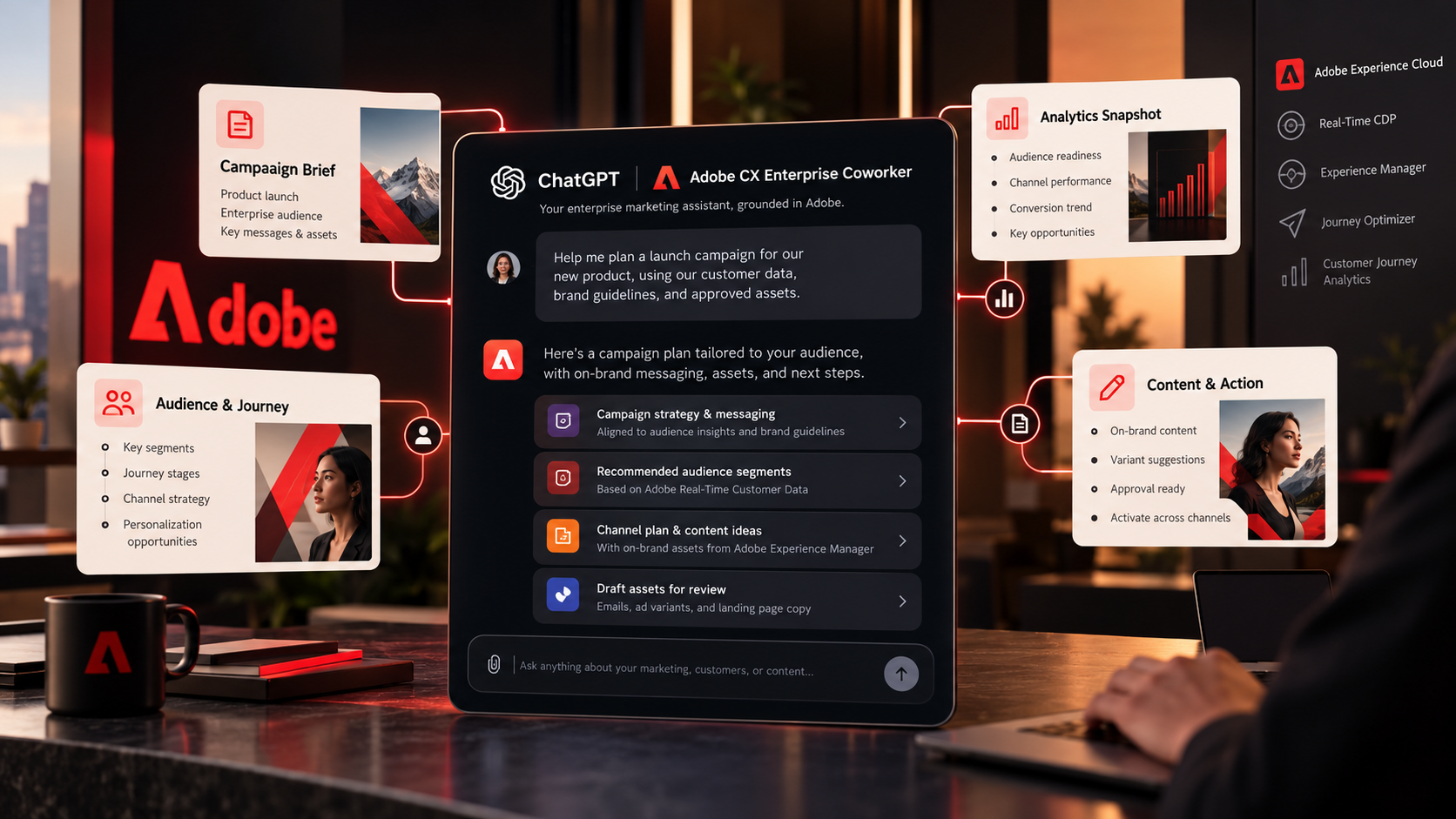
Adobe has expanded its OpenAI partnership by bringing CX Enterprise Coworker into ChatGPT. The move gives enterprise teams a way to bring Adobe customer-experience context and workflow capabilities into an interface many employees already use.
The bigger story is interoperability. Companies are beginning to expect AI systems to work across the software stack rather than forcing users to open a separate assistant inside every application.
What Adobe is bringing into ChatGPT
Adobe describes CX Enterprise Coworker as an agentic system for customer-experience work. Its ChatGPT integration is designed to make Adobe context and capabilities available through conversation rather than requiring users to start inside an Adobe product.
Adobe also says its broader partnership includes OpenAI Marketplace participation and Workfront support for OpenAI's Agents API.
Why interface consolidation matters
Enterprise workers already move between many applications. Adding a separate AI panel to every product can create another layer of fragmentation rather than solving it.
Bringing specialized capabilities into a common conversational surface can reduce that friction, provided permissions and data boundaries remain clear.
Context is what makes a specialist agent useful
A general model can help draft ideas, but enterprise workflows depend on company-specific information: campaign history, content, audiences, approvals and business rules.
The value of a specialist integration comes from grounding the agent in that context while still giving users a familiar way to ask questions and request work.
This creates new governance questions
When one interface can reach multiple enterprise systems, access control becomes critical. A user should only receive information and take actions that their existing permissions allow.
Organizations also need clear audit trails so important changes can be traced back to the person, agent and systems involved.
Workflows are moving across application boundaries
The older software model assumed that work happened inside one application at a time. Agent systems are pushing toward a model where the user's goal spans several tools and the AI coordinates across them.
That can reduce repetitive handoffs, but it also increases the importance of standards, connectors and reliable identity management.
Why this matters beyond marketing
Adobe's integration is one example of a larger shift: specialist software vendors are bringing their capabilities into general AI environments instead of expecting the general AI product to replace them.
For users, that could be a healthier direction because domain tools keep their depth while conversational systems provide a common control layer.
Sources and further reading
Read Adobe's CX Enterprise Coworker announcement
Explore more articles on the Nejma Blog
GOT ANY QUESTIONS LEFT?
It is Adobe's agentic system for customer-experience and marketing workflows, now integrated with ChatGPT.
It reduces context switching by letting users access specialist enterprise capabilities from a conversational environment they already use.
Permissions and governance become more complex because one interface can potentially reach sensitive data and actions across several systems.





